Keywords:
business, business / artificial intelligence
Sentiment:
positive
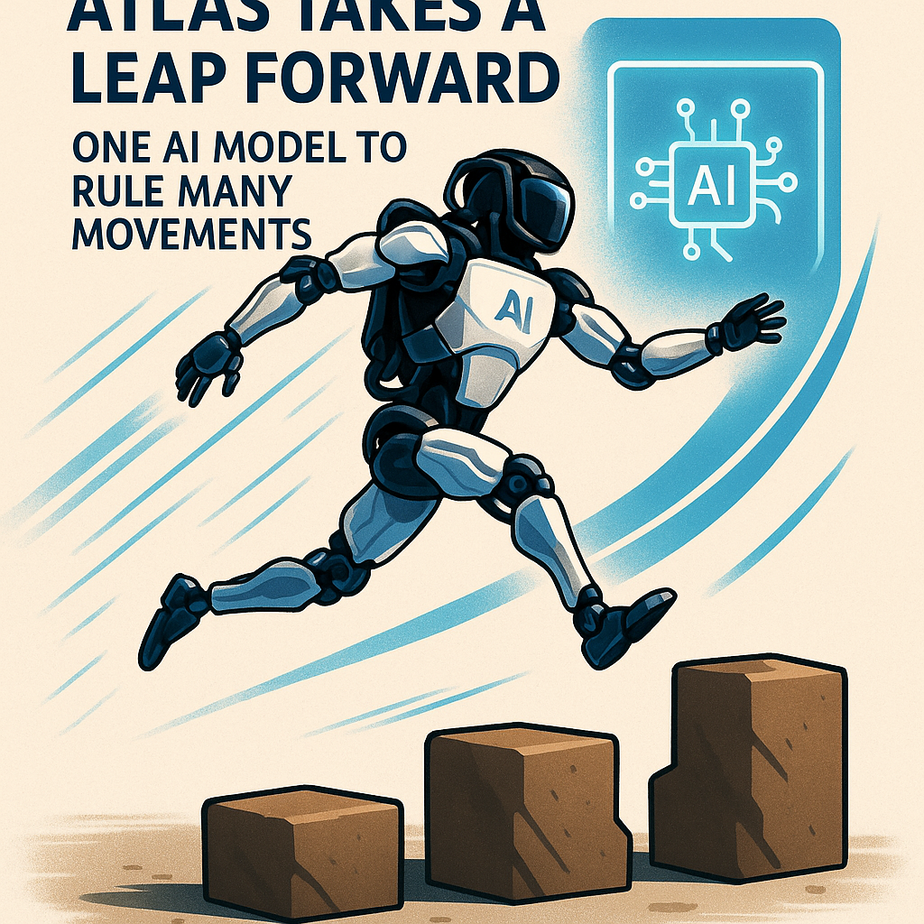
Boston Dynamics has once again pushed the boundaries of robotics with Atlas, their humanoid robot known for its impressive agility and coordination. The latest breakthrough is particularly exciting: Atlas now operates using a single AI model to handle a variety of complex tasks such as walking, balancing, and grasping objects. This unified approach marks a critical shift away from using specialized algorithms for each function, moving closer to the vision of a truly general-purpose robotic system.
Traditionally, robots have relied on multiple separate models or control systems to handle different types of movements or interactions with the environment. This division often results in inefficiencies and limits adaptability in unfamiliar situations. By consolidating locomotion and manipulation under one AI framework, Boston Dynamics not only streamlines Atlas’s capabilities but also opens the door for robots to learn and transfer skills more fluidly, similar to how humans develop motor skills in a holistic manner.
From a broader perspective, this development is a significant step toward creating robots that can seamlessly integrate into everyday human settings. Imagine a robot that can walk across varied terrain, pick up objects, and perform dynamic tasks without needing to switch between different software modules. This flexibility reduces the programming complexity and improves robustness, making robots more practical for real-world applications—from warehouse automation to assisting in disaster zones.
Moreover, the single-model approach enhances the robot’s capacity for real-time decision-making. Instead of rigidly following pre-set commands, Atlas can adapt its movements dynamically as scenarios evolve, relying on one cohesive understanding rather than juggling competing instructions from multiple models. This could be crucial when robots face unpredictable environments, where fluid adaptation is essential for safety and efficiency.
In conclusion, Boston Dynamics’ latest achievement with Atlas highlights the power of unified AI models in advancing humanoid robotics. While challenges remain in scaling these systems and improving their learning processes, this milestone brings us closer to robots that move, act, and respond with humanlike grace and versatility. The day when robots can effortlessly perform a wide range of tasks using a single intelligent system is not just a futuristic dream, but an emerging reality.
No statistics available at this time.

Source: https://www.wired.com
📋 Summary
Atlas, the humanoid robot developed by Boston Dynamics and the Toyota Research Institute, has advanced by using a single artificial intelligence model to control both walking and grasping actions, demonstrating emergent behaviors such as instinctively recovering dropped items. This generalist approach to robot learning, inspired by large language models, shows promise for more natural and versatile robotic abilities across various tasks, potentially marking a significant inflection point in applied robotics despite remaining challenges and the need for transparent evaluation.